Attribute Based Pedestrian Detection
Real-Time Pedestrian Attribute Detection with React and Flask
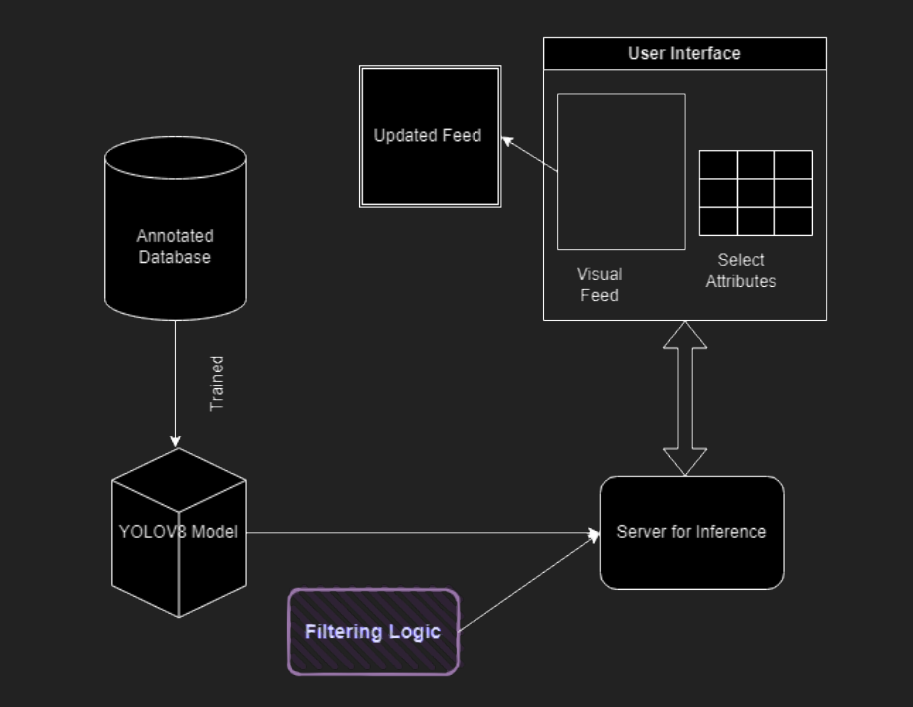
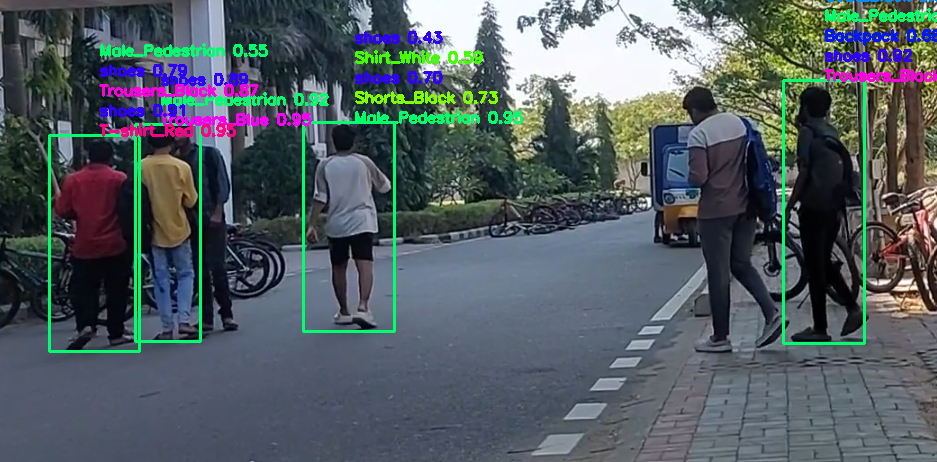
This project demonstrates a user-friendly application that leverages real-time camera feeds to identify individuals based on specific attributes. It highlights pedestrians with desired characteristics through bounding boxes, enhancing surveillance efficiency.
Technology Stack:
- Frontend: React
- Backend: Flask
- Deep Learning Models: YOLO variants
Project Structure:
notebooks: Jupyter Notebooks containing training runs for various YOLO models.app: React and Flask application code for user interaction and model integration.
Data Acquisition and Annotation:
The image data used for training the model originated from public datasets:
Supported Pedestrian Attributes:
The application can detect a wide range of attributes, categorized as follows:
| Category | Attributes |
|---|---|
| Gender | Male, Female |
| Upper Body | T-shirt, Shirt, Coat |
| Upper Body Color | Black, White, Red, Green, Blue, Yellow, Brown |
| Umbrella | Yes, No |
| Handbag | Yes, No |
| Backpack | Yes, No |
| Lower Body | Trousers, Skirt, Shorts |
| Lower Body Color | Black, White, Red, Green, Blue, Yellow, Brown |
| Footwear | Shoes, Boots |
| Glasses | Yes, No |
| Cap/Helmet | Yes, No |
Project Workflow:
Getting Started:
To run the application locally, you'll need to set up the required dependencies and environment. Please refer to the project's directory specific README files for detailed instructions.
Example Output:
Future Enhancements:
- Improved Model Training: Train a larger YOLO variant on a significantly bigger dataset encompassing a wider range of attributes for enhanced real-world performance.
- Granular Filtering: Implement more granular control over attribute filtering, allowing users to refine search criteria for precise results (e.g., clothing color, accessories, garment types).
- User Prompt Integration: Explore user prompts for pedestrian identification. The application could extract attributes (e.g., "red hat, backpack") and perform attribute-based detection for a natural interaction method.